
“Sierra Leone is an example of good practice when it comes to Disease Surveillance and Response…”
Deputy Minister of Social Welfare
Deputy Minister of Social Welfare, Mohamed Haji Kellah described Sierra Leone as an example of good practice when it comes to Integrated Disease Surveillance and Response as well as COVID. The Deputy Minister made this statement at the Closing Ceremony of the Training of Trainers Workshop for Health Workers held on Friday, 28th October, 2022 at the main hall of the National School of Nursing in Freetown, in appreciation of the tremendous effort Sierra Leone has made in response to disease outbreaks following the ebola outbreak in 2014. The Closing Ceremony followed a two week event of training of two Health Training Institutions: Eastern Technical University (ETU) in Kenema (17th to 21st October, 2022) and College of Medicine and Allied Health Sciences (COMAHS) in Freetown (24 to 28th October, 2022), in the delivery of community-based services, including cross-border disease surveillance and response.
Mr. Kellah noted that if people want to know the impact of the ebola and the lessons learned from it, it is necessary to look at what the government of Sierra Leone did in the COVID. He expressed profound thanks to the think-tank in this venture, with special reference to the Presidential Advisory Group and NACOVAC, and everybody that was involved in the coroner fight. These groups he said, gave the sense, pull the researches together and advised; they as line ministries, followed in terms of policies and clinical practices. He acknowledged the fact that there were very many good people when it comes to lessons learned from the ebola. He evoked memories of Dr. Khan and Dr. Willoughby, who lost their lives during the ebola, and those still alive like Dr. M’bawa, Dr. Mhamed Vandy, Satti Kenneh and many others whom he referred to as the Champions of Ebola.
MOSW Deputy Minister, Mohamed Haji Kellah Delivering the Closing Address
In the light of the PERSIF Project, the Deputy Minister admitted that they as a ministry, were very fortunate to have good people and agencies that helped them put the concepts together and of course, the funding from the African Development Bank (AfDB). He pointed out that, the three key policy areas where the PERSIF Project is situated are: human capital development, strengthening health systems and enhancing and promoting the quality welfare of the most vulnerable people in the country. He described the College of Medicine and Allied Health Science (COMAHS) as a center of excellence when it comes to medical practice and nursing studies in the West African region. He thanked the African Development Bank on behalf of the government of Sierra Leone for funding the project and hoped that they would continue to support Sierra Leone to become a developing country. He extended gratitude to the trainers and those that have been trained in particular, and encouraged them to be professionals in terms of imparting the knowledge gained from the training.
David Edward Lahai, Coordinator of the PERSIF Project who the success of the project lies squarely on his shoulders said, the PERSIF Project was inaugurated in 2015 to address those shortfalls that were very prevalent at the outset of the ebola outbreak. The focus he said, was to put in place mitigation measures and muster resilience to effectively respond to future epidemic resurgence. He informed that the project gives priority to training, infrastructural development and community engagement, adding, the project is benefiting districts hugely affected by the ebola virus disease (EVD) especially ebola hotspots and cross-border communities. Mr. Lahai however confessed that the project may not have all the answers but it can do justice to what went wrong and why. He touched on some of the capacity gaps that needed to be enhanced to achieve the project objectives. It was on this perspective he said the COMAHS and ETU partnership unfolded. The PERSIF Project Coordinator highlighted some key reasons why the two institutions were chosen to spearhead the training. According Mr. Lahai, ETU is the only institution in the Eastern Province of Sierra Leone that trains nurses, and Kenema being one of the hotspots districts when ebola impacted the country heavily, and that, COMAHS is the institution where healthcare training is renowned in Sierra Leone. He went on to state that the Project is supporting both the educational aspect, which would form part of the academic curriculum, and the community based aspect, which eventually would be the nurses and health workers to ensure that the surveillance system is enhanced to have a better response system and capacity.
Chairman of the occasion, Mohamed Sheriff, who spoke on behalf of the Coordinator of the Project Fiduciary Management Unit (PFMU) said the PERSIF Project was founded as a result of the serious impact of the ebola in the three Mano River Union (MRU) countries: Guinea, Liberia and Sierra Leone. According to Mr. Sheriff, the health systems of these countries were put to test at the time of the outbreak. He explained how the response to the then outbreak triggered a national agenda, supported by a regional and global agenda with the objective of supporting the health systems and livelihood of the people of these countries, and how to move forward in terms of responding to future outbreaks. These efforts he said brought the African Development Bank (AfDB) to the fore as funders of the Project. He shed lights on the reasons why the project was put on hold for a while and brought back to effective operation and pointed out that, there is no way to impact the health systems in the country without supporting the human capital.
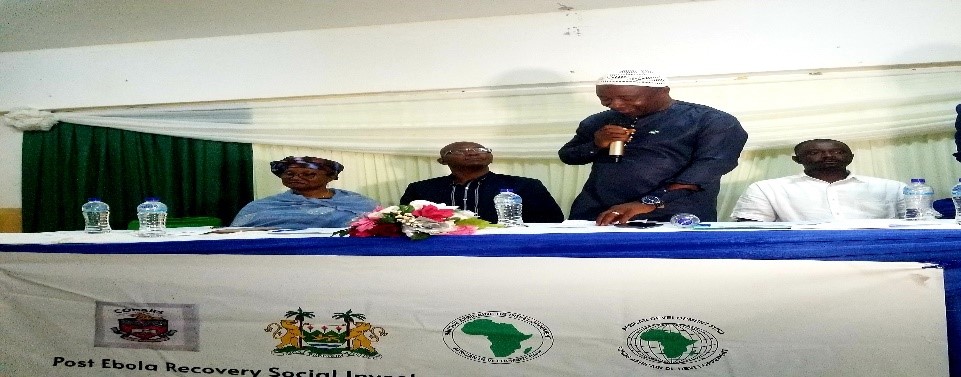
Deputy Minister of Social Welfare
Speaking on behalf of the Deputy Vice Chancellor of COMAHS, Dean of Faculty of Medical Laboratory, Science and Diagnostics, Associate Professor Isata Wurie spoke on the importance of the introduction of IDSR in Sierra Leone given the many diseases the country had and the challenges it faced before. He noted that because of the skills acquired in IDSR and lessons learned from the ebola, Sierra Leone was able to confront the COVID and sailed through. She shed lights on the response component of IDSR, the expertise in providing proactive interventions, the role of the frontline workers in all this and the effort of Sierra Leone in trying to implement the framework of the international health regulation which is now structured into a course for timely detection, proactive preventive and structure preventive intervention for Sierra Leone.
Prof. Haja Isata Wurie PFMU Mohamed Sheriff delivering opening address
COMAHS Head of Department of Community Health, Dr. Abdul Karim M’bawa said Sierra Leone faced a very serious challenge in terms of response when the ebola virus disease (EVD) broke out. He admitted that there were frontline workers in the field at the time but the EVD surprised them. As he put it, the IDSR Strategy was in place then but had not been developed in Africa. He disclosed that in order to strengthen the health capacity of the country, COMAHS developed modules in disease surveillance and response and integrated them into the curriculum. He acclaimed Sierra Leone as one of the countries that was less impacted by the COVID pandemic because of the resilience and experience of its healthcare workers in outbreaks. He emphasized from a World Health Organization (WHO) point of view that Sierra Leone and Tanzania are the only countries in Africa to develop an IDSR Strategy and Sierra Leone is the only country to train health workers in IDSR.
A cross-section of the trainees and students of Nursing School
Giving the vote of thanks, one of the beneficiaries of the training, Miatta Mansaray noted that the training was enlightening, informative and containing all the ingredients that would enable them to transfer skills to their students and frontline workers but appealed to the organizers to be conducting refresher trainings at intervals.
